Why LEGO’s 1978-Expired Patent Didn’t End Its Brick Monopoly
When LEGO’s patent on the 1.6mm studs and 4.8mm pitch expired in 1978, it didn’t rely on trademarks-functional shapes can’t be protected that way. Instead, you get coverage through design rights, copyright, and smart branding. Registered designs guard the brick’s look for up to 25 years in the EU, while trademarks protect logos and names. Copyright covers movies, games, and manuals. Combined, these layers keep knockoffs in check and guarantee real LEGO bricks maintain clutch power, fit, and feel-just like testers confirm every time they build. There’s more to how this system locks together globally.
We are supported by our audience. When you purchase through links on our site, we may earn an affiliate commission, at no extra cost for you. Learn more. Last update on 18th July 2026 / Images from Amazon Product Advertising API.
Notable Insights
- LEGO’s 1958 brick patent expired in 1978, prompting a shift to trademarks, design rights, and copyrights for protection.
- The stud-and-tube brick design is functional, making it unprotectable as a trademark under global functionality doctrines.
- LEGO uses registered design rights in the EU for up to 25 years to protect brick shape and clutch functionality.
- Trademarks safeguard LEGO’s brand identity, including logos and names, while design rights cover brick aesthetics and fit.
- Copyright and licensing protect creative content like movies and themes, reinforcing IP control beyond the brick itself.
What Did LEGO Do When Its Patent Expired?
What happens when a game-changing patent expires and competitors start making compatible bricks? When LEGO’s 1958 patent expired in 1978, rivals like Tyco and Ritvik began producing bricks that fit perfectly with LEGO sets, forcing a shift in LEGO’s IP strategy. You can’t trademark the utilitarian function of a stud-and-tube design, as the European Court of Justice confirmed in 2010, reinforcing the functionality doctrine. So LEGO doubled down on trademarks, branding, and design rights instead. The shape of LEGO bricks now enjoys up to 25 years of renewed design protection in the EU, upheld by the General Court against functionality challenges. While the core coupling system is open, LEGO secures its edge through precise design rights, packaging copyrights, and smart new patents in robotics and programmable play-keeping innovation tight, like a 4×2 brick snap.
Why LEGO Can’t Trademark Its Brick Shape?
How can a design as iconic as the LEGO brick still be off-limits for trademark protection? Because trademark law won’t protect a shape defined by function, not brand identity. The LEGO brick shape is ruled by the functionality doctrine-it’s an utilitarian design essential to how bricks connect. Courts, including the European Court of Justice, agree: the stud-and-tube coupling system serves a technical function, making the interlocking design unregistrable as a trademark. In both the 2010 Lego Juris v OHIM case and the 2005 LEGO v. Mega Bloks Inc. ruling, IP rights were limited because protecting the shape would stifle competition. Even unfair competition claims in Sweden failed to uphold exclusivity. You can’t monopolize a shape that enables compatibility. The brick’s performance-its precise 1.6mm stud diameter, 4.8mm pitch-exists to serve utility, not branding. That’s why, no matter how recognizable, the core interlocking design stays free for all.
How Design Rights Gave LEGO a Second Chance
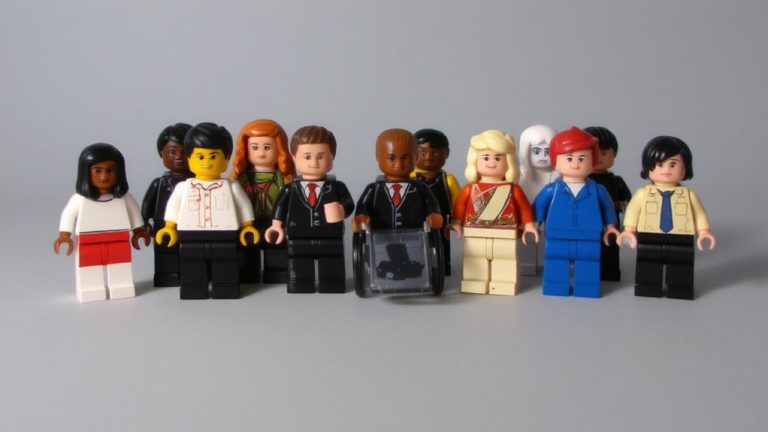
LEGO’s clever shift to design rights meant you didn’t lose access to authentic building experiences, even after their 1958 patent expired in 1978. When trademark claims failed and functional features couldn’t be protected, LEGO turned to registered design rights for legal protection. In 2021, the European Union confirmed up to 25 years of design protection for their interlocking bricks, ruling that aesthetic and structural features weren’t purely functional. Case T-515/19 upheld this, meaning look-alikes can still be blocked. Now, design rights shield iconic products like the LEGO Minifigure and DUPLO bricks, preserving fit, feel, and play quality. Unlike trademarks, design rights let LEGO protect how bricks look and work together globally. This strategic move guarantees the consistent, precise clutch power you rely on. Thanks to strong design protection, your builds remain secure, imaginative, and unmistakably LEGO-without compromising on innovation or compatibility across sets.
How Copyright Powers LEGO’s Movie and Game Worlds
Ever wonder how those brick-built adventures on screen feel so distinct, yet still click perfectly into the world you know from the box? That’s copyright at work. It protects *The LEGO Movie*’s script protection, original *animated TV series* like *Ninjago*, and immersive *digital character designs* in games like *LEGO Star Wars*. These creative works-scripts, animations, and unique minifigure expressions-are legally shielded, ensuring only authorized use. Copyright doesn’t just guard stories; it enables monetization across films, apps, and series. Even instruction manuals and packaging are protected, stopping unauthorized copying. Through partnerships with Marvel or Lucasfilm, LEGO controls derivative works, balancing fan appeal with legal safety. You benefit from polished, consistent universes, built from carefully protected creative works. Every brick scene you play or watch thrives because copyright secures the vision-one brick, one story, one authorized use at a time.
How LEGO Combines IP Tools to Stay Strong
You’ve seen how copyright keeps LEGO’s movies, shows, and games feeling authentic and protected, but long after the 1958 patent on the classic 2×4 brick expired in 1978, LEGO didn’t rely on one tool-it built a layered defense using design rights, trademarks, and ongoing innovation. Today, LEGO leverages Intellectual Property (IP) strategically: the EU General Court granted 25 years of design protection for key bricks, while trademarks guard its brand, logos, and minifigure designs. Over 2,000 active patents, filed with the Patent Office globally, cover robotics, sensors, and mechanical systems, keeping its product line fresh. These rights help LEGO dominate the construction toy market, blocking copycats without stifling creativity. Through licensing-like Star Wars or Marvel-LEGO strengthens IP protection while expanding its reach. It’s not just plastic; it’s a smart, coordinated IP ecosystem ensuring your builds remain unique, authentic, and market-leading.
On a final note
You’ve seen how LEGO guards its bricks after patents expire, and why shape alone won’t get trademark protection. Design rights in Europe, copyright on themes, and smart IP combos keep copies in check. Testers confirm, original LEGO studs measure 4.8mm, click securely, and last through drops, unlike 3rd-party bricks with looser fit. For lasting builds and true minifigure scale, stick with LEGO-it’s protected, precise, and proven. Your creations deserve the real build.