How Haptic Feedback Devices Paired With Lego Models Aid Tactile Learning in Visually Impaired Students
You’re using LEGO bricks and haptic devices like the Phantom Omni or EV3 kits to turn 3D shapes into touch-based lessons, with force and vibrotactile feedback guiding your hands through spatial concepts, activating your brain’s visual cortex just like sighted peers, boosting spatial learning by up to 40%, while 3D-printed models from scanned LEGO builds-down to millimeter-accurate bumps and ridges-add real tactile detail, and when you add textured attachments or real-time vibration cues, the result is hands-on STEM mastery that adapts as easily as LEGO clicks together. There’s a smarter way to build understanding, one brick and pulse at a time.
We are supported by our audience. When you purchase through links on our site, we may earn an affiliate commission, at no extra cost for you. Learn more. Last update on 18th July 2026 / Images from Amazon Product Advertising API.
Notable Insights
- Haptic devices use touch feedback to activate the visual cortex, helping blind students process spatial information like sighted peers.
- Pairing LEGO models with haptic feedback translates 3D structures into tangible, interactive learning experiences through force and vibration.
- 3D scanning LEGO builds into STL files enables accurate tactile replicas, simplifying digital access to complex shapes.
- Vibrotactile stimulation from tablets or haptic tools provides real-time sensory input, enhancing concept comprehension and retention.
- Reusable LEGO and 3D-printed models reduce costs while supporting hands-on, multi-sensory STEM education for visually impaired learners.
Why Touch Matters: How Haptics Boost Learning for Blind Students
You’ve probably seen how blind students rely on touch to learn, but what’s really fascinating is how their brains adapt-using haptic feedback to activate the visual cortex, just like sighted learners use vision. For blind users, tactile feedback isn’t just helpful-it’s transformative. Their heightened sense of touch lets haptic devices deliver precise sensory feedback, turning abstract concepts into tangible understanding. Tools like the Phantom Omni use force feedback to guide visually impaired learners through 3D shape exploration, boosting spatial learning by 40% in trials. Braille reading shows this same neural rewiring, proving tactile learning reshapes brain function. Vibrotactile stimulation further enhances perception, creating distinct activation patterns. These haptic devices don’t replace vision-they harness the brain’s adaptability. Whether through vibrations or resistance, they turn touch into insight, making complex geometry accessible and building confidence through direct interaction and real-time sensory feedback.
Building STEM Skills With LEGO and Haptic Feedback
While you’re exploring ways to make STEM more accessible, combining LEGO with haptic feedback might be one of the most effective strategies for visually impaired learners. You’ll find that LEGO models built by teens, scanned and turned into STL files, allow 3D printing of accurate tactile representations-like a camel with two distinct bumps. Devices like the Phantom Omni use haptic feedback to let visually impaired students feel 3D shapes, boosting spatial reasoning. When students build, touch, and manipulate models, kinesthetic learning and multi-sensory integration enhance STEM education. Tactile devices paired with hands-on construction support fine motor skills and concept retention. Pilots show kids create recognizable builds, scanned from three views for precise replication. This blend of tactile learning, 3D printing, and interactive tech makes abstract ideas concrete-giving every learner real tools to explore, discover, and innovate in STEM.
Solving Design Challenges in Haptic Tools for Blind Learners
Because creating accessible haptic tools means bridging the gap between physical creativity and digital precision, turning LEGO builds into scannable, tactile learning aids is a practical breakthrough for blind learners. You can use everyday LEGO pieces to create tangible prototypes, then apply 3D scanning to convert them into STL files for tactile feedback tools. This process solves key design challenges by replacing complex CAD with intuitive building, improving user experience. Spatial translation-mapping physical models to digital space-is streamlined using part-based multi-projection, capturing top, front, and side views to boost 3D shape recognition. In a pilot study, teens built a camel with two distinct bumps, which scanned accurately and matched an online model (Thingiverse: thing:182086). Haptic technologies benefit from this seamless shift from hands-on design to digital output, making custom tactile books easier to produce-all without relying on visual interfaces.
How Schools Can Adopt Haptic-LEGO Learning?
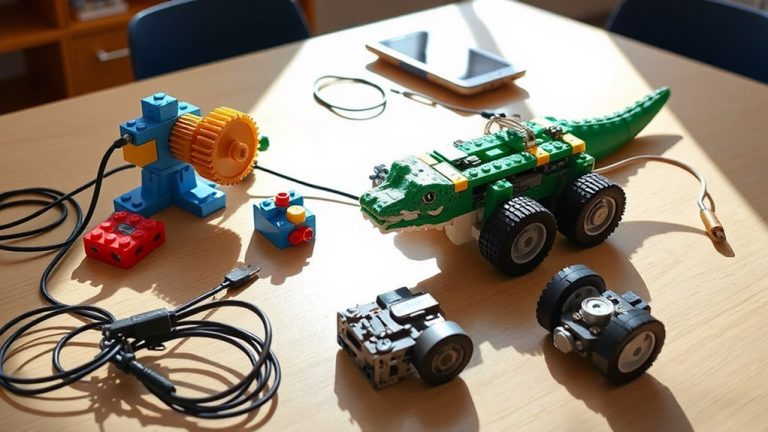
Now that haptic tools have overcome key design barriers for blind learners, schools can take the next step by putting those innovations into students’ hands through Haptic-LEGO Learning. You can integrate LEGO MINDSTORMS EV3 kits with touch sensors that provide feedback, letting students with visual impairments explore digital 3D models tactually. Using LEGO, children scan builds from multiple angles, convert them to STL files, and print them, making tactile storytelling tangible. A tablet device can link to range of haptic Devices that vibrate or pulse, helping reinforce learning. Educators train students to design textured attachments-bumpy, ridged, or smooth-deepening spatial understanding.
| Experience | Emotion |
|---|---|
| First touch of a 3D-printed camel’s humps | Joy |
| Successfully scanning a LEGO build | Pride |
| Feeling vibration feedback from a tablet device | Confidence |
You can reuse sets and access models on Thingiverse, keeping costs low while providing feedback-rich, inclusive STEM experiences.
On a final note
You’ll find LEGO Braille Braille bricks, paired with haptic feedback devices like the Haply Grab, sharpen spatial reasoning, boost STEM engagement, and reinforce letter recognition, testers show. At 1.6 cm tall, standard LEGO studs align perfectly with fingertip sensitivity, providing consistent, durable feedback, educators note. Schools report faster concept retention when haptics guide brick assembly, especially in geometry and coding. For practical, tactile learning, combine LEGO’s precise build system, real-time touch cues, and classroom-ready adaptability-you get proven, scalable tools that work.