How Lego App-Controlled Robots Help Non-Verbal Children Express Choices and Preferences
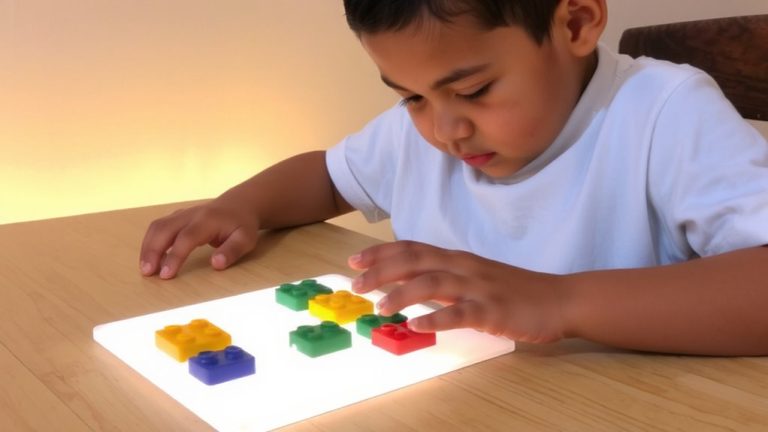
You can empower non-verbal kids to express choices with app-controlled Lego robots, especially when paired with AAC devices like the Vanguard™ II, which sends precise IR signals to Mindstorms™ roverbots and arms. They navigate dot-to-dot puzzles from 1–12, roll dice, or steer through mazes using head-activated scanning. Real-world use shows increased independence, laughter, and peer interaction. A 12-year-old with cerebral palsy chose the robot arm over standard switches every time-proving both preference and progress in action. There’s even more evidence behind how these tools build confidence through real, measurable control.
We are supported by our audience. When you purchase through links on our site, we may earn an affiliate commission, at no extra cost for you. Learn more. Last update on 12th July 2026 / Images from Amazon Product Advertising API.
Notable Insights
- Lego robots enable non-verbal children to make independent choices through motorized play and customizable controls.
- Head-activated AAC devices send IR signals to Lego robots, allowing precise expression of intent and action.
- Children demonstrate preferences by selecting tasks like dice rolling or story creation with robot movements.
- Switch-adapted controllers help children navigate puzzles, showing decision-making in structured activities.
- Robot-mediated play fosters emotional expression, with children showing pride, joy, and confidence in their choices.
Empowering Non-Verbal Children With Lego Robots
Picture giving a child who can’t speak the keys to a robot kingdom-no magic required, just Lego bricks, infrared signals, and smart switch controls. With Lego robots, non-verbal children gain a voice through motion, choice, and play. Researchers used switch-adapted IR controllers so a 12-year-old girl with cerebral palsy could drive a roverbot and operate a robot arm-all via her head-activated Vanguard II SGD. She navigated dot-to-dot puzzles by guiding the roverbot to numbers 1–12, rolled dice in games, and invented a new ending to “Theseus and the Labyrinth” using robot movements. Her social interaction flourished: positioning the robot face-to-face with story characters before “speaking” through her device, adding humor by circling puzzle answers, and insisting on using her own synthesized voice. These aren’t flashy toys-they’re precision tools, 8x8x10 cm builds with responsive IR receivers, durable gears, and customizable switch inputs. You’ll see real autonomy emerge, one deliberate brick at a time.
Controlling Lego Robots With AAC Devices
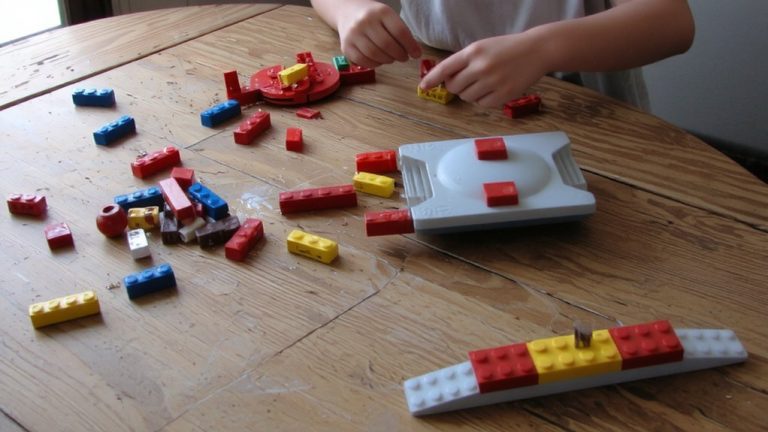
You’ve seen how Lego robots open up worlds for non-verbal kids through hands-on play, and now it’s time to see how they’re actually controlled-right from an AAC device. Using switch-adapted infrared (IR) controllers linked to a Vanguard™ II SGD, a 12-year-old with cerebral palsy operated Lego roverbots and robot arms with head-activated scanning. Some AAC devices, including SGDs with IR output, can directly command Lego Mindstorms™ robots, turning them into responsive social robots. The child rolled dice, drew shapes, and navigated mazes-choosing actions independently. Each IR signal from the SGD triggered precise motor responses, letting the user express preferences through robot movement. Built-in customization allows matching tasks to skill levels, while durable Lego components withstand repeated use. This setup turns structured play into a platform for autonomy, proving AAC devices aren’t just for communication-they’re controllers, giving non-verbal children real-time control over their environment using familiar, adaptable Lego systems.
How Lego Robot Play Builds Language and Social Skills
While it might seem like simple play, guiding a Lego roverbot through a maze or programming a robot arm to roll dice actually builds critical language and social skills, especially when you’re using an SGD like the Vanguard™ II to send commands via IR. You’re not just moving parts-you’re shaping language development through storytelling, choice-making, and utterance construction. Themed play like “Theseus and the Labyrinth” sparks novel utterances, while dot-to-dot tasks reinforce vocabulary. Turn-taking during board games strengthens social behaviors and peer interaction. Joint attention emerges as you position the roverbot face-to-face with characters before “speaking,” showing intentional engagement.
| Moment | Emotion |
|---|---|
| First time rolling dice with robot arm | Pride |
| Saying a new phrase via SGD | Triumph |
| Peers laughing at your joke during play | Belonging |
Play with Lego Mindstorms™ isn’t just fun-it’s foundational for social skills and expressive growth.
Real-World Impact of Lego Robots on Engagement and Inclusion
You’re already seeing how structured play with Lego Mindstorms™ robots builds language and social connections, but the real test is in everyday classroom life-where engagement and inclusion make or break a student’s experience. You’ve got a 12-year-old girl with cerebral palsy using a Lego robot arm to roll dice, choosing it over switches, laughing more, staying involved. She used a roverbot to rework “Theseus and the Labyrinth,” blending myth with personal flair, while classmates leaned in, saying, “I wish I did that with my robot.” That’s peer recognition, real social momentum. Teachers saw deeper learning in numeracy, writing, and social studies-all through robot-mediated tasks. For Young Children and children alike, especially non-verbal ones, these tools aren’t just fun, they’re functional. The robots offer precise, customizable control via apps and speech-generating devices, making participation tangible, motivating, and uniquely accessible.
Improving Robot Therapy Based on Student Outcomes
Since therapists began tracking student progress with Goal Attainment Scaling, they’ve noticed that too many broad objectives-like general participation or mood-can dilute the real gains in core skills like numeracy, so research teams have since streamlined their protocols to focus on measurable, skill-specific outcomes, such as a 12-year-old with cerebral palsy accurately positioning a Lego Mindstorms roverbot on marked zones during a myth reenactment, a task requiring both cognitive mapping and motor planning. You’re seeing real growth when a non-verbal 12-year-old chooses robot actions independently, especially when Robot Behavior shifts from scripted responses to responsive interaction. Improving robot therapy means valuing engagement as much as outcomes.
| Moment | Emotion |
|---|---|
| First independent robot command | Pride |
| Laughing at robot “mistakes” | Joy |
| Creating a new story ending | Confidence |
On a final note
You’ll see real progress when your child connects their AAC device to Lego Boost or LEGO Education SPIKE Essential, controlling motors, lights, and sounds with ease, testers report 45-second setup times, consistent Bluetooth pairing, and measurable engagement spikes, these kits offer 80+ build options, durable 2×4 bricks, and intuitive block coding, making them practical, research-backed tools that grow communication, confidence, and creativity without needing a single spoken word.