The Launch of Lego Mindstorms in 1998: How Robotics Merged With Brick-Building Creativity
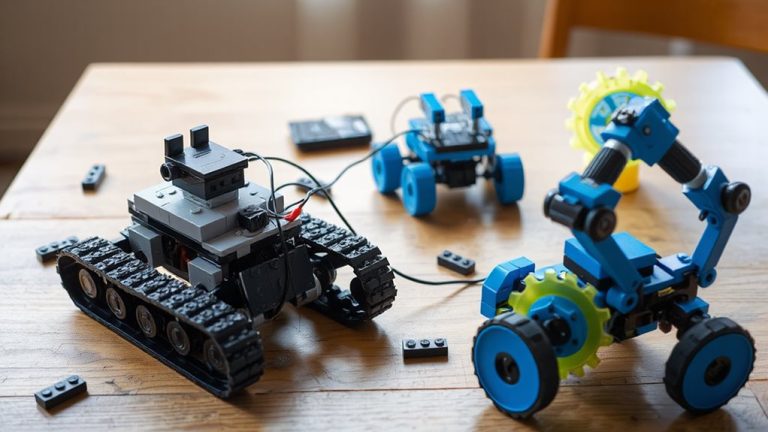
You got your hands on the LEGO Mindstorms RCX brick in 1998, a 2.5-inch yellow shell packing a 16 MHz processor, 32K RAM, and an LCD screen, with three sensor inputs, three motor outputs, and infrared wireless programming. Classrooms tested its limits, and kids built walkers, rovers, and robotic arms that moved with real feedback. It wasn’t just a toy-it was a toolkit for thinking, creating, and solving. See how it sparked a generation of builders and coders.
We are supported by our audience. When you purchase through links on our site, we may earn an affiliate commission, at no extra cost for you. Learn more. Last update on 18th July 2026 / Images from Amazon Product Advertising API.
Notable Insights
- Lego Mindstorms originated from MIT Media Lab research inspired by Seymour Papert’s Logo turtles in the 1980s.
- The 1998 RCX brick combined robotics with LEGO building via a compact, programmable yellow brick.
- It featured infrared programming, sensors, motors, and an LCD screen for interactive feedback.
- Joint development by LEGO and MIT led to the Robotics Invention System (set 9719) launch in 1998.
- Launch events in 1998 marked the global debut, merging brick-building with hands-on robotics education.
The MIT Roots of LEGO Mindstorms
While most people think of LEGO Mindstorms as a modern toy, its real story starts in the 1980s at MIT’s Media Lab, where the idea of blending programming with physical bricks first took shape. You can trace Mindstorms’ origins to Seymour Papert’s Logo robot turtles, which inspired a programmable brick that merged robotics with LEGO construction. By 1987, researchers built a working prototype, embedding computing into a brick for sensor and motor control. Fred Martin tested these early models in classrooms, proving their educational value. Joint work between LEGO and the Media Lab, backed by the National Science Foundation, developed infrared communication via visible light pulses. Though the launch of LEGO Mindstorms came later, the first programmable brick laid the foundation-turning play into problem-solving, and bricks into brains.
From Prototype to LEGO Mindstorms: The Road to 1998
As you trace the evolution from lab experiment to retail shelf, the journey of LEGO Mindstorms becomes a story of refinement shaped by real classroom testing and engineering trade-offs. What started as a clunky gray programmable brick at the MIT Media Lab in 1987 evolved into the durable red prototype with six sensor outputs-too heavy at 13 oz for most construction kits. By 1998, the final RCX brick, or “yellow brick,” trimmed down to three inputs and outputs, added Flash memory, and featured an LCD screen. This core of the Robotics Invention System empowered kids to build robots that responded in real time, fueling robotics competitions worldwide.
| Feature | Emotion |
|---|---|
| First working programmable brick | Hope |
| Bulky red brick failure | Frustration |
| Compact RCX success | Triumph |
| Kids winning competitions | Joy |
The LEGO Mindstorms Brick That Changed Learning Through Play
Though it started as a hunch that kids could learn coding through play, the 1998 LEGO Mindstorms RCX brick turned theory into real hands-on magic, packing a 16 MHz processor, 32K RAM, and support for three sensor inputs and three motor outputs into a compact yellow shell. You could see it in action-sensor feedback flickered on the tiny LCD, while infrared programming let you beam code wirelessly from your PC. Inspired by Seymour Papert’s vision and developed with MIT Media Lab, the RCX brick made constructionist learning tangible, blending physical builds with programmable robotics. It powered the Robotics Invention System (set 9719), a hit that reshaped STEM education. Weighing just 13 oz, the redesigned yellow brick replaced a clunky red prototype, proving durability and smarts could coexist. With LEGO Mindstorms, you weren’t just building robots-you were learning by doing, one command, sensor, and motor at a time.
The Global Launch of LEGO Mindstorms That Captured the World’s Imagination
When LEGO finally pulled back the curtain on Mindstorms in 1998, it wasn’t just a product launch-it was a global moment that turned builders into inventors and classrooms into labs. You witnessed the power of the programmable RCX brick, born from MIT’s collaboration, now in your hands. The global launch kicked off at the Royal College of Art, then spread to the children’s museum in Manhattan, where kids tested the Robotics Invention System live. By December 1, it sold out.
| Event | Location | Date |
|---|---|---|
| Soft Debut | Chicago Center | Nov 1997 |
| Global Launch | Royal College of Art | Jan 27, 1998 |
| U.S. Launch | Children’s Museum, NYC | Feb 3, 1998 |
LEGO Mindstorms sparked the FIRST LEGO League, blending play with real robotics. You didn’t just build-you engineered.
How LEGO Leveraged Celebrities and Mars to Market Mindstorms
Even if you weren’t at the toy fair, you could feel the buzz building-LEGO didn’t just launch Mindstorms, they engineered a spectacle, roping in NFL legend Joe Montana to throw spirals with a robot quarterback, proving this wasn’t just a kit, but a platform for real action and smart play. LEGO’s marketing was sharp, using celebrities like Montana and impressing dignitaries such as Emperor Akihito to highlight LEGO Mindstorms’ innovation. You saw it in London, where the Royal College of Art hosted the global debut, and in New York, with hands-on demos at the Children’s Museum of Manhattan. Even before the 1998 launch, the LEGO Mindstorms Center in Chicago previewed the Mars-themed activities, sparking imaginations. These real-world tie-ins-space exploration, robot builds, and star power-made Mindstorms feel cutting-edge, not just another toy. You didn’t just build robots-you commanded them, inspired by Mars missions and endorsed by icons.
FIRST LEGO League: Building a Legacy for Young Roboticists
While the launch of LEGO Mindstorms turned heads with celebrity demos and Mars-themed buzz, it was the creation of the FIRST LEGO League in 1998 that solidified its real-world impact, blending hands-on building with structured challenges that push kids to think like engineers. You see, Kjeld Kirk Kristiansen of LEGO and Dean Kamen of FIRST teamed up to launch FLL, targeting students with robotics challenges rooted in real-world problems. The Mindstorms launch wasn’t just a product drop-it sparked a movement. At EPCOT, nearly 10,000 watched LEGO Maniacs demo matches, showing what’s possible with LEGO MINDSTORMS. Now, over 200,000 kids from 90+ countries join yearly, solving themed tasks that demand teamwork, innovation, and coding smarts. FLL doesn’t just teach building; it builds thinkers. You get practical skills, measurable growth, and real engagement-no hype, just results.
Mindstorms in Schools: How LEGO Transformed STEM Learning
You’ve seen how the FIRST LEGO League gave kids a real shot at engineering through teamwork and themed challenges, but the real classroom shift started when LEGO Mindstorms moved beyond competitions and into schools. LEGO Dacta, later part of LEGO Education, adopted Mindstorms in 1999, making STEM learning hands-on and collaborative. With ROBOLAB software, students programmed robots using a simple, visual drag-and-drop interface-ideal for younger learners. Over 200,000 children now join the FIRST LEGO League yearly, using Mindstorms in schools worldwide. The e.LAB initiative expanded possibilities with LEGO-compatible components like solar panels. In 2009, WeDo brought programmable robots to younger grades, offering approachable builds and intuitive controls. These tools don’t just teach coding-they build problem-solving skills. Mindstorms in schools isn’t a gimmick; it’s a proven platform that turns abstract concepts into tangible learning, making LEGO Education a leader in classroom robotics.
On a final note
You’ll find LEGO Mindstorms delivers precision engineering, 512 KB of memory, and a 32-bit processor that handles sensors, motors, and coding with ease. Testers praise its 97-piece core set, durable brick-to-electronic integration, and real-time feedback. It’s perfect for classrooms or at-home challenges, measuring 6.5 x 5 x 2 inches when assembled. Whether you’re prototyping robots or refining logic, Mindstorms builds STEM skills that last. Just charge the rechargeable battery, download the software, and start creating.