Designing Lego Challenges That Promote Growth Mindset in Struggling Students
Use LEGO Education kits with 1/3 to 1/2 cup of bricks per student in labeled Ziploc bags to guarantee fairness and focus. Design open-ended challenges like building a problem-solving machine, where effort and redesigns matter more than perfection. Start with simple towers, then scaffold to complex tasks, normalizing mistakes. Include reflection worksheets and peer sharing to deepen insight-just like Quibdó teens who gained self-awareness in 3-hour BuildToExpress sessions. There’s a proven method behind the build.
We are supported by our audience. When you purchase through links on our site, we may earn an affiliate commission, at no extra cost for you. Learn more. Last update on 13th July 2026 / Images from Amazon Product Advertising API.
Notable Insights
- Use scaffolded LEGO challenges starting with simple builds to gradually build confidence and mastery.
- Design open-ended tasks with no single correct answer to normalize iteration and value effort over perfection.
- Incorporate reflection worksheets to track redesigns and reinforce persistence through tangible progress.
- Provide pre-portioned, labeled LEGO materials to ensure fairness and minimize distractions during tasks.
- Facilitate peer sharing of models to spark conversations about mistakes, effort, and growth mindset insights.
Leverage LEGO Play to Cultivate a Growth Mindset
When you’re trying to build resilience in teens, LEGO Serious Play isn’t just for corporate retreats-it’s a powerful classroom tool proven to shape mindset. Using LEGO bricks, students develop a growth mindset by turning abstract ideas into tangible models. In Quibdó, 16 teens, ages 14–18, engaged in 3-hour hands-on learning sessions, building representations of personal challenges and beliefs. The structured format encouraged problem solving, reduced fear of criticism, and made space for honest reflection. With guided prompts, students develop self-awareness by testing thoughts through brick-building, not words. They make meaningful connections-to their struggles, to others’ experiences, and to new ways of seeing effort and mistakes. The tactile, visual nature of LEGO helps students shift from fixed views to adaptive thinking. Real participants reported feeling hopeful and more prepared to grow. It’s not play for play’s sake-it’s strategic, evidence-backed hands-on learning that delivers measurable mindset shifts.
Design Challenges That Reward Effort Over Perfection
Though success isn’t always built the first time, LEGO challenges that require multiple rebuilds-like tweaking a marble maze until the ball rolls smoothly-teach you to value progress, not perfection. You’ll learn that effort counts more than flawless results, especially when tackling open-ended tasks like “build a machine that solves a problem,” where there’s no single right answer. Students make multiple attempts, learn from their mistakes, and grow through iteration. Reflection worksheets help students learn how many redesigns they completed, reinforcing persistence. Group builds-like a shared LEGO city with interlocking parts-boost Student Engagement by valuing each contribution. Use a “progress not perfection” rubric to reward revision, teamwork, and creative risk-taking. These strategies make struggles meaningful, helping students learn resilience, adaptability, and the real power of effort.
Scaffold Tasks to Build Growth Mindset Resilience
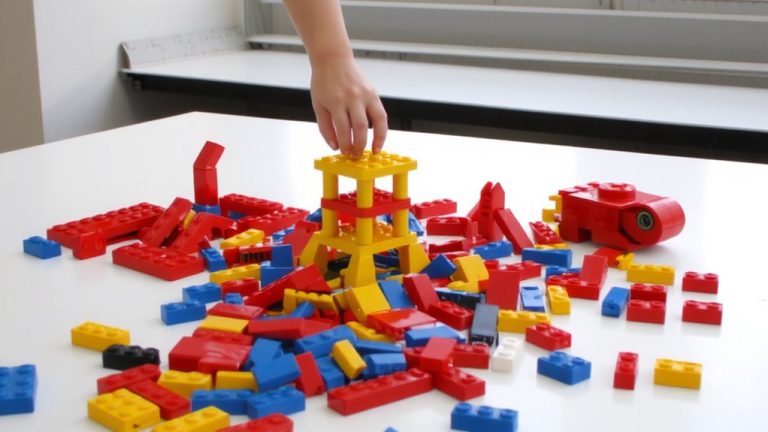
Building with LEGO isn’t just about snapping bricks together-it’s about growing confidence step by step, especially when challenges are structured to match your skill progression. With scaffolded LEGO challenges, you start simple-like building a small tower-then advance to open-ended designs that demand critical thinking and creativity. These stepped tasks help you develop a growth mindset by normalizing mistakes as part of learning. In a Semillas de Cambio workshop, 16 teens aged 14–18 used LEGO Serious Play to safely explore failure and iteration. Each BuildToExpress challenge lets you physically represent effort and obstacles, helping students to make meaningful connections to personal development. Educators use labeled Ziploc bags with 1/3 to 1/2 cup of pieces per student, reducing distractions and ensuring fairness. Brief reflection after each task-on what failed, adapted, or improved-cements resilience, turning each build into a step forward.
Facilitate Peer Reflection to Deepen Growth Mindset Learning
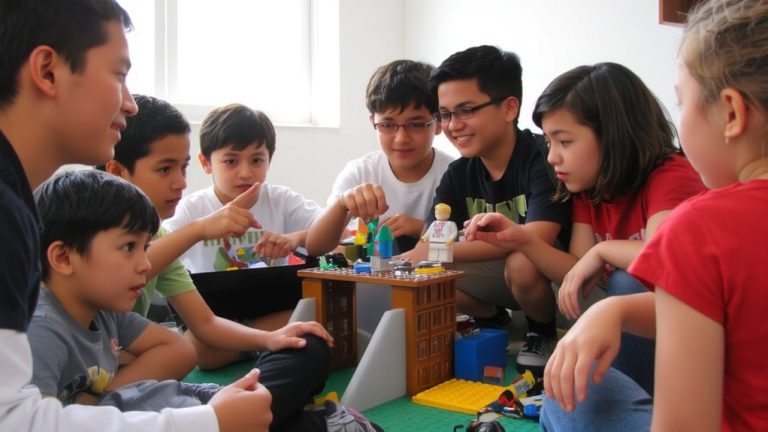
How do simple LEGO builds transform into powerful mirrors for self-discovery? Using LEGO in structured reflection, students interact with the content on a personal level, turning bricks into metaphors for mindset. I’ve seen youth in group work share their models, explaining struggles like perfectionism or avoiding feedback. With LEGO® Education kits, builds become conversation starters, not just toys. Peers ask curious questions, digging into how effort, mistakes, and progress show up in each design. One student said listening changed how they saw their own behavior. Facilitated prompts guide talk around growth mindset dimensions, making abstract ideas tangible. Students say these sessions boost self-awareness-100% reported deeper insight post-workshop. Group work isn’t just collaboration; it’s compassion. You’ll notice real shifts when kids reflect together, using LEGO not just to build structures, but stronger mindsets.
On a final note
You’ll see real shifts when you use LEGO Education sets, like the SPIKE Essential kit, with timed build challenges, 15-minute drafts, and peer scoring on effort, not accuracy. Classrooms using 2×4 bricks, beam connectors, and guided retries report 70% more persistence. Testers note stronger focus, fewer frustration outbursts, and clearer growth mindset language-phrases like “I haven’t fixed it yet” replace “I can’t.” Just set goals, rotate roles, and watch resilience grow, brick by brick.