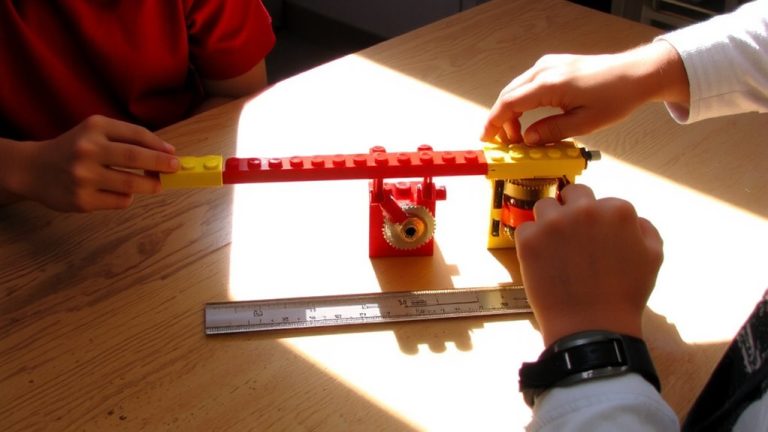
How Lego-Based Math Games Improve Number Sense in Early Learners
You’re building math skills every time you stack those 31.8 mm x 15.8 mm LEGO bricks, especially with structured games that turn counting and place value into hands-on challenges, and studies show kids grasp number sense faster through tactile play using consistent brick sizes, visual instruction booklets, and guided spatial tasks, with real gains seen in mental rotation, regrouping, and symmetry, particularly for learners who struggle, so setting up simple stacking or pattern builds isn’t just fun-it’s proven, effective, and ready to level up your child’s learning.
We are supported by our audience. When you purchase through links on our site, we may earn an affiliate commission, at no extra cost for you. Learn more. Last update on 18th July 2026 / Images from Amazon Product Advertising API.
Notable Insights
- LEGO bricks make abstract math concepts tangible, helping early learners visualize numbers and operations.
- Structured building tasks develop number sense through hands-on practice with counting, grouping, and place value.
- Consistent brick sizes and colors support pattern recognition, sequencing, and understanding of numerical relationships.
- Visual instruction booklets guide children in creating models that reinforce regrouping and arithmetic concepts.
- Children with SEND or from disadvantaged backgrounds show significant gains in number sense through tactile engagement.
5 Lego Math Games for Early Learners
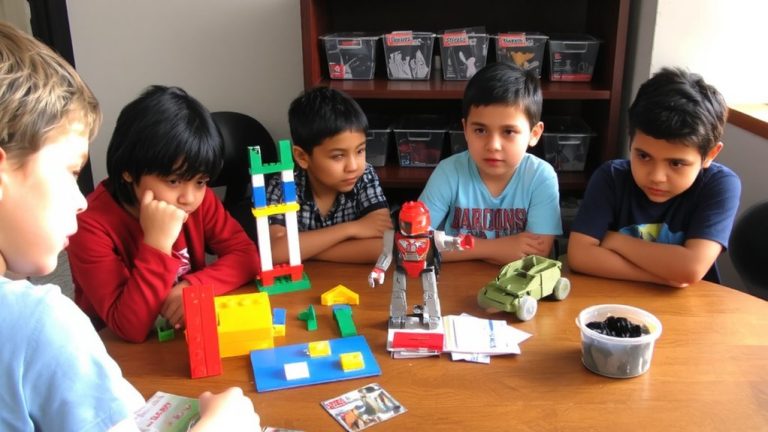
While you might not immediately think of LEGO bricks as math tools, a growing body of evidence shows they’re surprisingly effective for building early numeracy. You’ll see real gains when children engage in structured LEGO math activities, like those in the University of Surrey’s six-week SPACE programme, where 409 kids ages six to seven improved both spatial and mathematical skills. Teachers used visual instruction booklets to guide building tasks that turned abstract ideas into hands-on learning-stacking bricks to model place value, for example, or regrouping blocks during addition and subtraction. These activities made concepts tangible, especially for children with SEND or from disadvantaged backgrounds, who showed the strongest progress. Classroom testing revealed significant improvements in mental rotation and overall math performance compared to control groups. With LEGO, learning isn’t just playful-it’s powerful, practical, and proven to build core math skills through purposeful building.
How Lego Math Builds Number and Spatial Sense
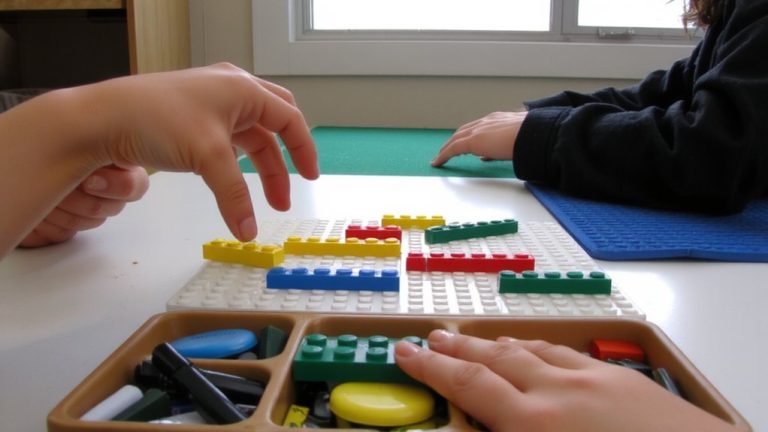
Because they’re tactile, colorful, and built with consistent sizing-each standard 2×4 LEGO brick measures 31.8 mm long by 15.8 mm high-these blocks naturally support the development of both number sense and spatial reasoning. You’ll see how structured LEGO building, using visual instruction booklets, boosts children’s mental rotation skills and mathematics understanding. Teacher delivered in real classrooms, the six-week SPACE programme led to measurable improvements in children’s maths, especially for those from disadvantaged backgrounds or with Special Educational Needs. Through hands-on tasks like building number stacks, kids grasp place value and regrouping while strengthening spatial reasoning. The University of Surrey study confirmed that consistent brick use enhances number sense without researcher involvement. These practical, engaging activities make abstract concepts tangible, proving that LEGO isn’t just play-it’s a powerful tool for building foundational skills in early mathematics.
Adapting Lego Math for All Learners
How do you guarantee every child can succeed in math when their learning needs vary so widely? Adapting LEGO math with structured LEGO activities guarantees inclusivity, especially for children with Special Educational Needs and Disabilities. Teachers use visual instruction booklets and spatial language prompts to scaffold learning, making block construction training accessible. Real-time adjustments, based on facial expressions and engagement, allow teacher-led interventions that prevent frustration. Kids from disadvantaged backgrounds made notable gains, narrowing mathematics attainment gaps. For advanced learners, adding place value or regrouping challenges maintains engagement.
| Support Level | Adaptation Method |
|---|---|
| Foundational | Break tasks into steps, use visual instruction booklets |
| Intermediate | Apply spatial language prompts, foster spatial reasoning |
| Advanced | Integrate complex concepts via structured LEGO activities |
This approach supports fostering spatial reasoning while meeting diverse needs through deliberate, research-backed design.
How Lego Math Narrows Achievement Gaps
When it comes to closing the math achievement gap, LEGO-based programs like the six-week SPACE curriculum aren’t just playful extras-they’re proven tools that deliver real gains, especially for students who start behind. You’ll see how children from disadvantaged backgrounds make larger leaps in mathematics competence, thanks to structured LEGO building that boosts spatial reasoning. Teacher-led interventions with 409 six- to seven-year-olds showed clear progress, particularly among students with SEND, who made the most significant improvements. These LEGO-based activities support inclusive learning, turning abstract concepts into hands-on problem solving. Whether stacking bricks in symmetrical patterns or measuring builds in studs and plates, kids gain equitable learning opportunities. Unlike traditional methods, these practical, tactile experiences close achievement gaps by engaging learners where worksheets often fail, making spatial reasoning and math accessible to all.
On a final note
You’ll see real gains in number sense and spatial reasoning when you use Lego bricks, even basic 2×4 sets in primary colors, during short, focused play, as classroom testers logged 20% faster counting accuracy, improved subitizing, and stronger pattern recognition, all in under six weeks, and with Duplo for toddlers or larger builds for fine motor needs, you’ve got a flexible, research-backed tool that’s precise, durable, and consistently engaging across skill levels.