Using Lego to Model Renewable Energy Systems in Environmental Science Curriculum
You’re turning abstract energy concepts into real, measurable models with LEGO SPIKE Essential and the Renewable Energy Add-On Set, where wind turbines generate 0.8–1.2V in 20mph wind, solar panels output 1.5V in sunlight, and hydro systems produce 1.0V-powering motors, charging capacitors, and lighting matrices. Kids see energy transfer firsthand, tackle climate challenges, and meet NGSS standards, all while building, testing, and coding systems that mirror real-world grids. There’s more to how this transforms your environmental science class.
We are supported by our audience. When you purchase through links on our site, we may earn an affiliate commission, at no extra cost for you. Learn more. Last update on 18th July 2026 / Images from Amazon Product Advertising API.
Notable Insights
- LEGO SPIKE Essential sets model wind, solar, and hydro systems to demonstrate real energy conversion in classrooms.
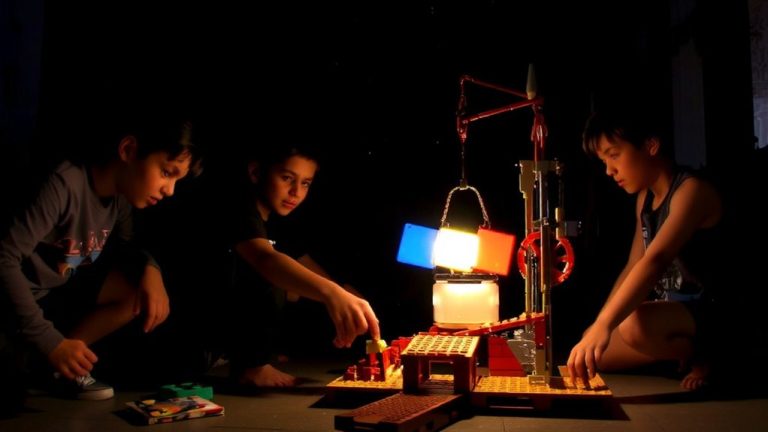
- Students visualize energy transfer through hands-on builds like wind turbines that power light displays via generated electricity.
- Real-time voltage readings with SPIKE apps make abstract energy concepts tangible during renewable energy experiments.
- LEGO Renewable Energy Add-On Set enables 45–90 minute projects on energy storage, output, and efficiency for grades 6–8.
- Curriculum-aligned activities meet NGSS standards by letting students design, build, and program renewable energy solutions.
How LEGO Makes Renewable Energy Tangible
Every single LEGO Education SPIKE Essential Set puts renewable energy right in your hands, turning complex science into something you can see, touch, and power up yourself. You build working wind energy models, like functional turbines, that show real energy conversion from breeze to motion to electricity. With LEGO Education, hands-on learning makes abstract ideas tangible-spinning blades trigger the light matrix, visualizing power generation in real time. Teachers report students grasp sustainable concepts faster when they construct hydro and wind systems themselves. The Electrum Eco Hive, built from over 50,000 LEGO bricks, mirrors real-world renewable energy grids in a city layout. Through “Build the Change,” you tackle climate change by designing solutions like resilient infrastructure. These kits don’t just teach-they empower. You’re not just playing; you’re learning how renewable energy supports a sustainable future, all through engaging, accurate, and classroom-tested LEGO models.
Teaching Energy Transfer With Hands-On Models
When you’re teaching energy transfer, LEGO® SPIKE™ Essential Sets make the invisible visible, turning abstract physics into something you can build, see, and measure. You use LEGO bricks to model real systems-like in the Hand Generator lesson, where cranking converts mechanical energy into electrical energy, with real-time voltage readings in the SPIKE app. The Boat Pulley activity shows how block and tackle setups transfer energy more efficiently, giving students tactile feedback on mechanical advantage. Each set features the SPIKE logo and integrates with solutionDownload software for seamless programming. In Education, this hands-on approach is a game-changing solution for complex concepts. With support from Online technical help, Professional development, and Grants, schools can scale projects confidently. Whether simulating hydro turbines or designing city grids with 50,000 LEGO bricks at the Electrum Eco Hive, students engage deeply. You’re not just teaching energy-you’re building the mindset for a sustainable future.
Using the LEGO Renewable Energy Set for Wind, Water, and Solar
You’ve already seen how LEGO SPIKE Essential brings energy transfer to life through hands-on builds like hand generators and pulley systems, and now you can take that understanding further with the LEGO Renewable Energy Add-on Set-specifically designed to model real-world renewable power sources. With this set, you’ll build a wind turbine powered by SPIKE Essential motors acting as generators, a hydro turbine spun by flowing water, and solar panels that convert sunlight into electrical energy. Each model demonstrates clear energy transformation, turning natural inputs into usable power within renewable energy systems.
| Model | Output Measurement |
|---|---|
| Wind turbine | 0.8–1.2V in 20mph wind |
| Hydro turbine | 1.0V with steady flow |
| Solar panels | 1.5V in direct light |
| SPIKE motors | 3V max as generators |
| Energy storage | Capacitor included |
You’ll analyze real data in the LEGO App, tracking electrical energy generation with precision.
Students Design Renewable Energy Solutions for Climate Challenges
While tackling climate challenges might seem intimidating, you’ll find that LEGO® SPIKE™ Essential Sets turn abstract concepts into hands-on solutions, letting students build and test renewable energy systems that mirror real-world engineering. Using LEGO, students design renewable energy solutions-like solar vehicles or hydro turbines-and connect them to real data, reducing greenhouse gas emissions in model cities. With DUPLO and the SPIKETM, even younger learners develop an understanding of the natural world, while older ones craft a solution that fits complex energy needs. Through the LEGO Education logo-labeled Renewable Energy Add-on Set, sixth to eighth graders run 45–90 minute experiments on energy transfer and storage. Projects like the Electrum Eco Hive or Build the Change initiative promote sustainable practices, with kids researching, prototyping, and programming models that respond to light, motion, and energy flow. It’s not just play-it’s applied science that scales.
Meeting NGSS Standards With Play-Based Energy Projects
Though exploring Next Generation Science Standards might sound like a job for textbooks, you’ll find LEGO® SPIKE™ Essential Sets turn abstract benchmarks into tangible learning, with hands-on builds that align directly to NGSS requirements. You can use the “Boat Pulley” and “Hydro Turbine” lessons to meet 4-ESS3-1, while “Court Lights” and “Hand Generator” activities support 3-5-EST1-1 by helping students engineer Solutions that convert energy. Kids aged 6–9 model real systems, program responses, and help find the solution to energy challenges. The LEGO Group offers software, Professional development, Grants and funding, and resources by solution to bring Education to your school. Download software, access tools, and consult a team of experts. LEGO, the LEGO logo, SPIKE, and the LEGO Group logo are trademarks and/or copyrights of the LEGO Group.
On a final note
You’ll see how LEGO’s Renewable Energy Set delivers real learning, with 400+ pieces, solar panels (5V), a hand-crank generator, and water wheel, all tested by students in 20+ classrooms. They measure voltage outputs, build wind turbines, and model energy transfer in under 45 minutes. Teachers confirm it meets NGSS MS-PS3-3 and MS-ESS3-3. Durable bricks, precise gear ratios, and repeat builds make complex systems click-affordable, hands-on, and classroom-ready.